When “I’m Fine” Becomes Workplace Culture
When “I’m Fine” Becomes Workplace Culture
May is Mental Health Awareness Month.
If we are being honest, most people do not need another reminder that mental health matters. They already know. They feel it in the exhaustion they cannot quite explain, in the moments where they stare at a screen for an extra minute before responding to one more email, or in the pressure of carrying too much while telling everyone around them they are “fine.”
At work, it often sounds familiar.
Someone says they are just tired, that things are busy right now, or that everything will settle down after the next deadline, the next project, or the next season. At home, the language shifts slightly, but the feeling remains the same. We tell ourselves we just need to get through this week, that everyone needs us right now, or that rest can wait until life slows down.
The challenge is that life rarely slows down on its own.
What starts as coping can quietly become a lifestyle. Weeks turn into months, months become years, and somewhere in the middle of trying to keep everything moving, people stop asking themselves an important question:
Am I actually okay?
Mental Health Awareness Month matters because it creates space for conversations many people have been postponing, often with themselves.
The truth is, we have become incredibly skilled at coping. We know how to push through exhaustion, manage stress, meet expectations, and continue delivering even when we are stretched too thin. In many workplaces, that ability is quietly celebrated. Productivity is rewarded. Dependability is praised. The people who carry the heaviest loads often become the people everyone leans on.
But coping and healing are not the same thing.
Healing asks something different of us. It asks us to slow down long enough to acknowledge what is really happening beneath the surface. It invites us to recognize that exhaustion is not always a sign of weakness or poor resilience. Sometimes it is simply evidence that someone has been carrying too much for too long.
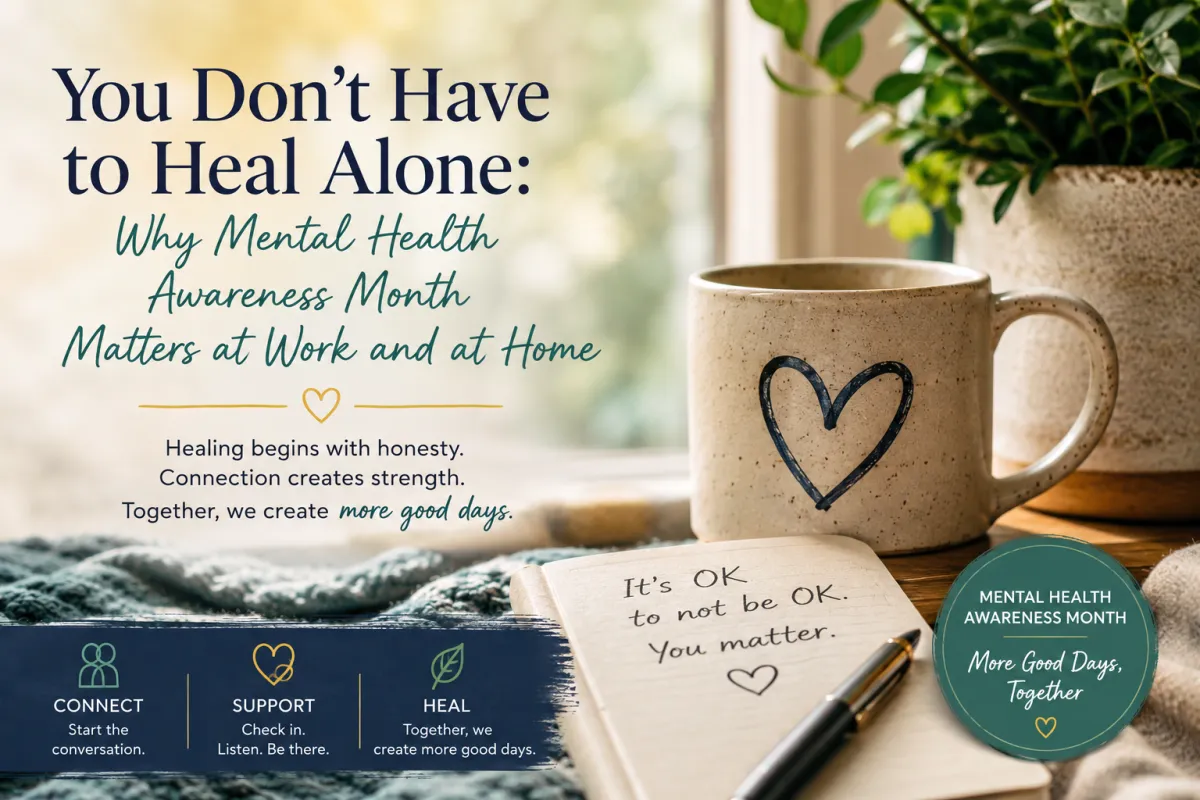
This year’s Mental Health Awareness Month theme, “More Good Days, Together,” feels especially timely because it shifts the conversation away from fixing people and toward supporting them. It reminds us that healing rarely happens in isolation. More often, it happens in safe conversations, in supportive environments, and in moments where people feel seen enough to stop pretending everything is okay.
The Hidden Cost of Coping Culture
One of the biggest workplace challenges we rarely talk about openly is the culture of coping that quietly develops in organizations.
Many workplaces unintentionally reward the very behaviours that eventually lead to burnout. The employee who always says yes becomes the dependable one. The manager who absorbs pressure without complaint becomes the strong leader. The team member answering emails late into the evening is praised for commitment and work ethic.
At first glance, these behaviours look admirable. In many cases, they are rooted in good intentions. People care about their teams, their work, and their responsibilities. The problem is not commitment. The problem is what happens when commitment turns into chronic overextension and silence becomes the norm.
After years of working across workplace safety, training systems, onboarding, investigations, and organizational culture in both Canada and the United States, one truth becomes difficult to ignore: people often struggle long before anyone notices.
Not because leaders do not care, and not because employees are incapable, but because many workplace environments unintentionally teach people that struggle should be managed privately.
Over time, people begin to believe that asking for help signals weakness, that overwhelm is simply part of the job, or that honesty may quietly affect how they are perceived.
The cost of that silence is significant. It impacts trust, communication, morale, retention, and psychological safety. Burnout is not always dramatic or obvious. Sometimes it looks highly competent. Sometimes it looks like the person everyone relies on. Sometimes it looks like someone smiling through a meeting while quietly wondering how much longer they can continue carrying the weight alone.
Healing at Work Starts With Psychological Safety
This is where workplace culture matters more than we sometimes realize.
There is a term that appears often in conversations about leadership and healthy teams: psychological safety. While it may sound like corporate language, the idea itself is deeply human.
At its core, psychological safety asks a simple question:
Do people feel safe enough to tell the truth here?
Can someone say:
“I need help.”
“I am overwhelmed.”
“I made a mistake.”
“I do not understand.”
Or even, “I am not okay.”
Without fear of embarrassment, punishment, judgment, or quietly being labeled as difficult?
That level of honesty matters more than many organizations realize because healing at work is not simply about offering resources. Employee assistance programs, wellness benefits, and training initiatives matter, but trust must come first. People access support when they believe it is safe to do so.
As organizational psychologist and leadership researcher Amy Edmondson explains:
“Psychological safety is not about being comfortable. It is about being able to be honest.”
When honesty becomes possible, workplaces begin to shift. Communication improves. Questions are asked earlier. Misunderstandings decrease. People feel supported instead of isolated.
Work does not heal people. But healthy workplace cultures can stop making healing harder.
Healing at Home: The Other Half of the Story
What happens at work rarely stays at work.
Stress follows people home in ways we do not always notice at first. It shows up in shorter patience, interrupted sleep, emotional exhaustion, missed conversations, or the feeling that even after a long day, the mind never truly turns off.
Someone may leave the workplace physically, but mentally they are still replaying the difficult meeting, carrying the unresolved tension, or quietly wondering if they are falling behind.
The opposite is true as well.
What happens at home follows people into work. Family stress, caregiving responsibilities, financial concerns, grief, relationship challenges, and personal struggles do not disappear when someone clocks in.
For years, workplace culture often encouraged people to separate these worlds completely, as though personal life and professional life existed in neat little boxes. But anyone who has worked with people long enough understands that human beings do not work that way.
We carry our experiences with us.
We carry pressure.
We carry hope.
We carry worry.
And sometimes, whether at work or at home, we carry far more than anyone realizes.
This is why conversations around mental health matter beyond awareness campaigns or wellness months. They matter because people are trying to navigate life while still showing up for responsibilities, expectations, and the people counting on them.
Healing does not happen because someone suddenly has more free time or because life becomes easier. More often, healing begins when people feel safe enough to acknowledge what they are carrying and supported enough to stop carrying it alone.
Healing Happens in Connection
One of the strongest messages emerging from this year’s Mental Health Awareness Month is simple, but deeply important:
Healing happens together.
That idea challenges something many workplaces and individuals still quietly believe, which is that people should simply manage better, toughen up, or figure things out privately.
Yet healing has always been relational.
People heal in conversations.
In supportive teams.
In trusted friendships.
In communities where honesty is met with curiosity instead of criticism.
At work, this does not mean leaders suddenly become therapists or that organizations are responsible for solving every personal struggle. It means creating cultures where people feel respected enough to speak honestly, safe enough to ask for support, and valued enough to know they matter beyond performance metrics.
Sometimes healing at work looks surprisingly simple.
A manager who notices someone seems withdrawn and asks, “How are you really doing?”
A leader who says, “You do not have to carry this alone.”
A colleague who normalizes asking for help instead of quietly struggling.
Small moments matter more than we sometimes realize because trust is rarely built in grand gestures. More often, trust is built in consistency.
In listening.
In noticing.
In creating spaces where people feel seen.
As researcher and leadership expert Brené Brown reminds us:
“We are hardwired for connection.”
That truth matters in our homes, our workplaces, and our communities. Connection does not remove hardship, but it changes how hardship is carried.
🧠 Common Sense Insight
Mental health awareness is not only about recognizing struggle.
It is about creating environments where people feel safe enough to stop hiding it.
The strongest workplace cultures are not built on perfection or constant productivity. They are built on trust, honesty, and the belief that people deserve support before they reach burnout.
Rediscover, Reimagine, Reconnect
At Holy Pierogy, we often talk about three ideas:
Rediscover. Reimagine. Reconnect.
While those ideas often begin as personal reflection, they apply just as powerfully to workplace culture.
Sometimes rediscovery means recognizing that pushing through exhaustion is no longer sustainable.
Sometimes reimagining means asking what leadership, communication, and support could look like if we prioritized people alongside performance.
And sometimes reconnecting means rebuilding trust, with ourselves, with our teams, and with the people around us.
Because healing rarely starts with massive transformation.
More often, it starts with a pause.
An honest conversation.
A moment where someone finally feels safe enough to say:
"I am struggling."
And another person responds:
"Thank you for telling me. Let us figure this out together."
Reflection Questions for Leaders & Teams
Mental Health Awareness Month offers an opportunity to pause and reflect, not just personally, but organizationally.
Consider these questions for yourself or your team:
For Leaders
Do people on my team feel safe asking for help?
What signals am I unintentionally sending about burnout, workload, or vulnerability?
When someone struggles, do I respond with curiosity or correction?
Have I created an environment where honesty feels safe?
For Teams
What helps people feel supported here?
Where do we communicate well, and where do people quietly struggle?
How do we normalize asking questions or admitting overwhelm?
What would help this workplace feel more human?
The goal is not perfection.
The goal is progress.
Even one honest conversation can begin changing culture.
🕊️ Closing Thoughts from the Common Sense Files
Mental health awareness matters because people matter.
Not only when they are productive.
Not only when they are performing well.
Not only when they seem resilient.
But always.
Healing is not linear, and it rarely happens in isolation. People carry more than they say, both at work and at home. Sometimes the strongest thing someone does all day is simply show up while quietly carrying something heavy.
That reality deserves compassion, not assumptions.
As leaders, coworkers, family members, and communities, we have an opportunity to make healing feel less lonely.
Sometimes that starts with better systems.
Sometimes it starts with healthier boundaries.
And sometimes, it starts with one simple question:
“How are you really doing?”
Because common sense may tell us to keep pushing through.
But common ground reminds us something more important:
No one heals alone.
And no one should have to.